Thursday, October 27, 2016

Scenery from Canyon, Texas - 9/11/1916


Canyon Texas
Sept. 11, 1916

Dear Parents: -

We are just pulling out of Canyon Texas. Our route had to be changed a trifle, as the train was too heavy to take a route that ran through a very mountainous region.

I wrote Gerald Claybaugh to send clothes to S.M. J. Co. express collect.

The scenery is great and I think I have some fine pictures.

Our new route will possibly cut the length of the trip a day or so short, but guess it can't be helped.

I got four films at Canadian, have enough now to last me the remainder of the trip, unless it is made longer than is thought to be.

All O.K.
Howard

1st Ohio Amb. Co
Fort Bliss
El Paso Tex.

Historic train depot in Canyon
 
Wikimedia commons shows the above as "Historic train depot in Canyon" although it's undated. It looks later than Howard's time, but it may have been similar in 1918. Regardless, it's a stark contrast to the grand Union Station of Kansas City.
 
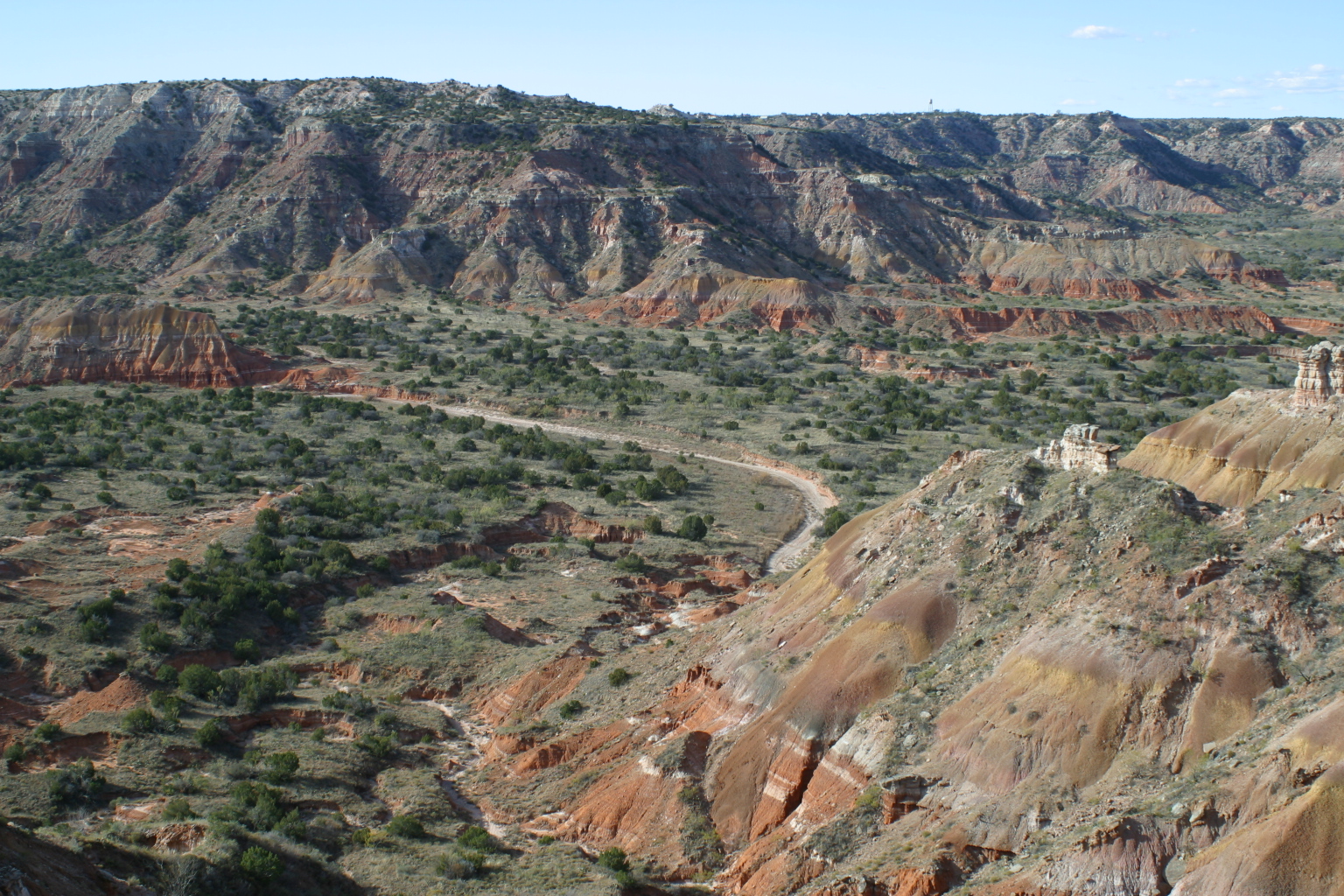
Image result for palo duro canyon historical 
 
Wikimedia also helped out with the above image - obviously not to the period and potentially not visible from the train - but it at least gives you an idea of the views from the Palo Duro Canyon.
 
Little known fun-fact: Artist Georgia O'Keeffe lived in Canyon, Texas at the time that Howard was riding through. She was a faculty member at West Texas State Normal College at the time, and it's believe that she was inspired the Palo Duro Canyon in her distinctive Southwest style.

Wednesday, October 26, 2016

Through St. Louis and Kansas City - 9/10/1916


Kan. City, Mo.
Sun, 10, 16

My Dear Parents: -

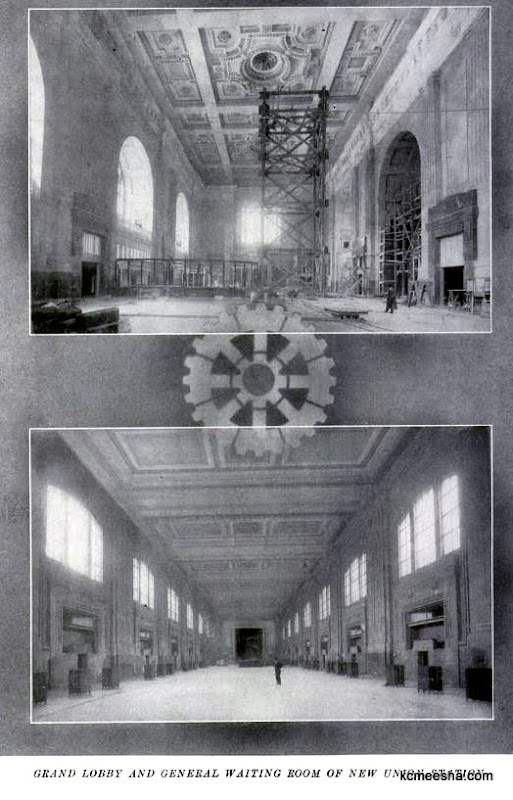
We are stopping over here for dinner and to replenish our ice & water supply. They have a grand depot here now, one like you read about in story books.

We crossed the Miss. river at 9:40 Sat night. Our route from Toledo was Marion, Ind.; Oakland, Ill; St. Louis. Mo.; Glasgow, Mo; Kan City, Mo.; Gardin, Mo.; Trinidad, Colo.; Albuquerque, N.M. & Ft Bliss, at El Paso Tex.

We changed engines at St. Louis, directly in front of the Hoyt Metal Co, from which the folding cup came that Dad had in the fruit basket.

At Charleston, Ill., and Kan City we got off and marched for a half hour to limber up.

We (Lisle, Sergt Walker & myself) had our Sunday dinner out of the box and some Lemonade, there was enough left so that we will be able to get our supper from it, and what is left in their boxes.

We are sure having a swell trip, and at every station which stop to get water, etc., a crowd is there to greet us.

Love to all
Howard

This will probably be mailed at the next station.

Kansas City's Union Station is impressive by today's standards, let alone to an 18-year-old from Ohio in 1916. When Howard stopped in Kansas City, Union Station was only two years old. It cost $8,000,000 to build, and an estimated 100,000 people arrived on opening day.

Tuesday, October 25, 2016

On the Train to El Paso - 9/8/1916


On Train
Sept 8, 1916
1:00 P.M.

My Dear Parents: - At last we are out of Camp Willis, the last ones to leave. We loaded the trains last evening and entrained this A.M. about 10:30. Gov. Willis came to the crossing and shook hands with each one of us.

Don't believe anything the papers say about our being tried for walking out of camp, because they have made an awful mess of everything that they have printed so far.

The only probable outcome of the affair will be a day or two of extra details and better eats.

There was no violence nor breaking into stores, etc., we just took a little vacation. We had a good time the two days we were in jail and were treated fine. The only reason they put us there was because it was the only place that they could accommodate 32 fellows.

As soon as I have a decent opportunity I will tell you all about it.

There is no disgrace connected with anything we did and it is taken as a joke.

We are going to Ft. Bliss at El Paso and expect to return at least by Nov. the first. Please don't worry about me for I am having a good time and feeling fine.

Love to all
Howard


The above photo is courtesy of Alexander F. Barnes and shows National Guardsmen boarding the train that will carry them across the country to Mexico in 1916. It's unknown from which state these guardsmen hail.

Troops were mostly transported in Pullman tourist train cars, so their comfort was generally good considering the long journey. According to the Railway Age Gazette from December 1916, "Official reports from all military departments showed that no organization moved in coaches in less space than three men to every four seats and wherever possible two seats for each man."

I could not find the newspaper articles that Howard references online (romantic date with microfilm to come). Interestingly enough, I did find a similar article in July 1916 that mentioned a company from New York who stopped in Cleveland for food, who acted in a similar manner that Howard described (breaking into stores, looting, etc.). I wonder if that was the running theme to sell papers at the time.

Monday, October 24, 2016

City Prison Cafe - 9/6/1916


Columbus, Ohio
Wed, Sept. 6, 1916

My Dear Parents: - 

You have probably heard about our company walking out Mon. because of the rotten food. We got caught before night and are in the city prison. I don't know whether or not we will get out before Sat. The eats here are better than those we got at camp. I am O.K. & don't want you to worry. We are not in single cells, but are all together, 32 of us are here in the lockup. We sing & raise the dickens in general. They treat us grand here and are all in sympathy with us. I am sure that the penalty will not be mush as the whole company are practically are refusing to do anything until we are properly fed. Don't worry if you don't hear from me for several days.

Howard


The above is a photo from the Columbus Metropolitan Library, showing the Columbus City Prison where Howard dined on fine food with his compadres in 1916. The prison burned in 1920. 

The city prison also served as the police headquarters at the time. I can imagine that the "jailers" probably did their best to make the boys as comfortable as possible. It sounds as if they may have even been more comfortable than at Camp Willis!

In his next letter (sent in the same envelope with this letter), Howard alludes to the newspaper coverage of this story, so I'll try to dig that up for next time. 

Sunday, October 23, 2016

Last Men Standing - 9/3/1916


Camp Willis, O
Sept 3, 1916

Dear Dad: - 

Mother's letter of the 1st. rec., rec. letter & card from Marion. Got a letter day or two ago from Merrick Hill, and one from Al Saal.

Well, 4th, 5th, 8th Regiments, Battery, Cavalry, Signal Corps 2nd Amb. and 2nd Field Hosp. have gone, about 7,000 or 7,500 in all. Only about 2,000 left.

Getting pretty darn lonely around here now. We still expect to get out of here by Sat. next.

There are about 30 or 40 Toledo visitors at our company today.

Weather has been great, nights fine for sleeping.

Feeling fine and anxious to get moving. 

Love to all
Howard

Got a nice letter from Leona yesterday.


The above is listed as a "novelty postcard" from the UA archives. Guessing that Howard wouldn't have had much to do other than to "dream" about going off to El Paso.

As quickly as Camp Willis went up, it was dismantled just as quickly, later becoming Upper Arlington's business district. When all was said and done, Camp Willis itself was seen as somewhat of a debacle for the Ohio National Guard. Many of the men who came to Camp Willis enlisted amidst a period of great patriotism - they were ready to stand and fight for their county. However, the site for Camp Willis wasn't ready to receive them, which is why many other states' units were called to the border before Ohio's. Guardsmen arrived to shortages in equipment and drilled for weeks without any news of when they would be moved to the border. Understandably, morale was low, considering the men had enlisted with the understanding they'd be moved quite quickly to battle the Mexicans. "Either go into Mexico or go home" was a popular slogan for troops at Camp Willis.  (Kingseed)

I found some interesting information about Al Saal on Magicpedia (who knew?). Al was a few years older than Howard, perhaps a friend of the family. He gave his first show as a magician at age 18, dressing in Spanish costume, doing card and cigarette manipulations. He is known as being the first magician to manipulate fully-lit cigarettes. He eventually retired from the "business" and became an undertaker. 

Saturday, October 22, 2016

Pinching Pennies - 8/27/1916

Camp Willis, O.
Aug. 27, 1916
My Dear Mother: -

As I want to get this on the night mail, I shall just write a few lines.

Pretty cool all day, with a slight shower now and then.

Only one visitor from Toledo at our camp today. I was at the station with one of the fellows when the train came in. From the looks of the crowd I don't think there were more than 40 or 50 people from Toledo.

I am sending you a receipt, which was in my note book. Guess you had better keep it for me.

We had a fine dinner & supper today. Am feeling fine.

Love to all
Howard


Wow, Howard. You really know how to impress a mama with those receipts! I guess all of his accounting prowess runs in his blood, considering his father John was a treasurer at an oil company. Not surprisingly, <Spoiler alert!> Howard never ended up in the medical profession after the war. Rather, he continued in business like his father. In 1930, the census listed him as buyer in an auto factory. In 1940, he was a purchasing agent like his father before him.

Minding pennies must have gotten the Goods far. John and Effie had live-in "servants" as listed in the census in 1920, and Howard and Leona also had servants living with them when my Grams and her sister Sue were small in 1930. I find it kind of funny that the only "hoity toity" branch to be found in my family tree is the Goods, considering that Grams was adopted and we're not related by blood. Only white trash running through these veins!

Friday, October 21, 2016

Farewell, Columbus Girl - 8/18/1916

Aug. 18, 1916
 
Dear Dad: -
 
Well, I have learned that "Students" in such collages as Yale & Harvard were the only ones who could get discharges. I only asked for a "Leave of absence",  but the "Skipper" said, "Nothing doing."
 
I put on my application that the reason was to finish Hi school work in order to prepare myself to take up surgery. Capt. said that since that was my inclination, that he would make me assitant "sawbones." You see there is one sergt. and usually one assist. who dishes out the pills etc. and who gives the propholaxis and such other disease preventitive treatments.
 
They have been drilling us so hard lately that I don't always get a chance to write when I want to but I shall write every chance I get even though it may be several days before I get a chance.
 
Wed. night I was with my Columbus girl again. I spent the evening at her home, had a peach of a time. I am going to see her again Sat if I get my pass, as it will be my last chance, we expect to leave here by the middle of next week. It was said that we shall be rushed to some place as about half of the high militia officers have threatened to resign if they soon don't see active service, they say that they all have better paying jobs, which are going to ruin becuase of their being held here, and they claim that the worse of it is that they are not doing anything here for any great benefit of their country.
 
If we leave as is said I shall have my clothes sent to you at the company.
 
I am feeling better every day. My stomach is getting used to this rotten regulation grub that we get shoved to us and I think that I shall begin to pick up a little weight presently.
 
I got a letter from Miss Ruth Felt yesterday. That makes about about a half a dozen letters I have rec. from her since coming here.
 
Marion's letters came today with the pictures. Thank her for me for sending them.
 
Love to all
 
Howard
 

Another "peach" of a photo from the UA archives is above. I'm sure Howard got his fair share of beans!

Howard references sending his clothes to "the company". The envelope of this letter was addressed to the "S.M. Jones Co., Segur Ave." where John Good likely worked. According to Ohio History Central, the company's founder, Samuel Jones, became rich after striking oil near Lima and founding the Ohio Oil company, which later became Standard Oil. He was known for providing his workers fair wages and safe working conditions and eventually ran on his "Golden Rule" philosophy for mayor of Toledo in 1897. He won the election and died in office in 1904. We don't know exactly what John did at S.M. Jones in 1916, but in 1910, his occupation was listed on the census as a Treaurer for "Mfg Gas Engines". In 1920, he was working as a purchasing agent in oil supplies.

I guess this letter answers the question about my previous post about whether Howard was engaged to Leona...or at least I hope he wasn't after his mention of his "Columbus girl"! Considering that I can't find record of Leona ever living in Columbus,and, that Howard mentioned her by name in the previous letter, I'm guessing they're not the same person.

The Leona/Columbus Girl question got me to thinking more about Howard's situation, especially his age. At the time of this letter, Howard would have only been 18 years old. The application for his veteran's headstone states that his enlistment date was April 27, 1915, which meant he was only just 17 when he joined the National Guard. Another interesting detail is that Leona was three years older than Howard. So, it makes more sense that 17 year-old Howard wouldn't have likely proposed to 20-year-old Leona before he even finished high school. I'm looking forward to seeing hints of how their relationship may develop in future letters.


Thursday, October 20, 2016

French Leaves and Lost Letters - 8/9/1916


9:00P.M.
Camp Willis, O,
Aug 9, 1916
Dear Dad - 

At last I have a few minutes to myself. We drilled about 7 1/2 hr. today, which included about a 6 mile hike.

They are getting as strict as the devil around here now, we cannot leave camp to go to town anymore without a pass.

The Provost Guard stationed in the business section of the city are all armed with 35 rounds of ball-shot. This was done because of the trouble the rough-necks of the Infantry made when they went to the city. The guard is about 150 strong.

They court-martialed our 1st class private and our serg't, who took a "French Leave" of three days, this morning, the serg't was fined 6 days pay ($7.20) and confined to Co. street for 2 weeks, the 1st class private got 5 days fine ($3.00) and 5 days at hard labor at the 4th Reg. Guard house.

They draw 4 names a day for 48 hr. furloughs, if I am lucky I may get a chance to come home before we leave. I still have 60 cents and the fare is only $4.90 round trip. They keep telling us that pay day is not far off, they have been telling us that for the last 3 weeks. I don't know whether there is $5.00 in camp or not, besides some change needed for street-car fare and Beach fare, but if I get a furlough I will try to manage to make is some way or other.

I got a letter from Lamont's girl yesterday, she thinks that it is awful because Lamont can't come home whenever he takes a notion to do so.

I haven't heard from Leona since a week ago Tues., don't know whether or not she is back in Toledo yet.

I got a letter from cous. Anna Souder yesterday, she did not know to what Co. I belonged and the letter was sent to the 3rd. Reg., then to the 5th Reg., then to the 1st, 2nd., and 3rd. Field Hospitals, then to the 1st Amb. It was everywhere except the Signal Corps, and the Calvary & Battery.

Everything is about the same in camp, two of the fellows who took French Leave Sunday have not returned yet. 

Got a letter from Clarence Forman today, telling me he had been married 3 months and wouldn't change place with a single man for the world.

I feel better every day.

Love to all
Howard


The above image is from the Upper Arlington Archives, depicting the Post Office that bungled the delivery of Howard's letter from Anna Souder. Anna was the daughter of Howard's Aunt Ellen, his father's sister.

Howard's daily schedule likely was as follows, which was reported by a correspondent with the Kenton newspaper at the time:

Morning the first call is made at 5:30, the assembly is at 5:45, and mess at 6:15. The troops drill from 7:40 until 11:00.  Mess is at 12:00, and drill begins at 1:30 and continues until 4:15.

Guard mounting call is at 4:40 and assembly is at 4:50. Mess is at 6:00. The men have the evenings, but the call to quarters is at 9:45 and taps at 10:00.

As Howard alludes to, his company was one of the State Medical Units - the 1st Ambulance Company which hailed from Toledo. According to Cole Kingseed's thesis, pay at the camp ranged from $16.67 per day for general officers to $4.72 for second lieutenants to $1 for sergeants. Howard was only a private at the time, so he would have earned 60 cents per day. 

This is the first mention of Leona, my great-grandmother. She and Howard were married in late summer 1920. Thus far, it is unknown whether they were engaged before Howard left. Leona was a nurse, so she likely would have had much in common with Howard in the ambulance unit.

Wednesday, October 19, 2016

The Storm at Camp Willis - 7/31/1916 and 8/2/1916


Camp Willis, O,
July 31, 1916
My Dear Mother -

I certainly had a good time Sunday when Uncle Tom was down.The feed he brought was great. I had my three meals out of it today and have some for tomorrow.

I guess he was all-in when evening came. There was a nice breeze all day but it was hotter than H---. The only thing that saved him was the thought of the fact that my woolen clothes were much better than his.

When I was coming home from the station, I met a man & his wife named Whitker. they knew Rev. Reeder of Toledo & Mrs. Phoebe Curtis. He said he had been on programmes with Mrs. Curtis. I showed them the camp by night and took them back to the car.

Received a letter from Ruth Felt Saturday. She is the same old girl.

(Same letter, continued)
August 2, 1916

At last I've formed time to finish my letter.

Everything was quiet & nice, with a few dark clouds in the north when suddenly the wind started to blow about 100 miles per.

The dust which was an inch thick on the ground made it impossible to see a thing. About 500 tents were blown down, blankets, clothes, hats & personals were scattered for miles. Many things were found at least three miles from where they started. All of our company were at Col.at the ball game. 

Only a few were at camp who did not care to go to the game. I was one at camp.

We managed to save all our own tents but two. I did not lose a thing & nothing of mine got wet or damaged.

One of the 2nd Field Hospital's men came around a corner of a building when the wind picked up and then threw him about 40 ft. against a building and knocked him senseless. About an hour later after the storm we found him there under a pile of debris. He's able to be around now. The wind took the roofs off the mess shacks & sure made some awful mess to clean up afterward. Everything was mixed up and many fellows lost everything they had.

Lightning struck several tents and burned them up. Four small circus tents used by the Army Y.M.C.A. were totally destroyed.

In one park uptown, over 75 trees were blown over, according to papers. It blew tops of street cars off & near camp where the land is high it carried about all the chimneys down.

I was not hurt, but am pretty sore in the back from tugging at tent ropes, etc. It rained for an hour after the wind so hard that the mud was nearly a foot deep.

I rec. your letter this A.M. I seem to stand the heat alright and feel better now than at any time since arriving here.

Love to all
Howard

Rec Marion's and Dad's letters also.

The above photo from the Upper Arlington, Ohio archives depicts soldiers of the 4th regiment and the tents to which Howard alluded. In spring 1916, President Woodrow Wilson called for the mobilization of the Ohio National Guard to assist in a campaign to seek and punish Pancho Villa for a raid in Columbus, New Mexico. At that time, Upper Arlington was a newly formed city, which was completely taken over when 8,000 National Guard troops used Camp Willis as a place to prepare for the protection of the U.S./Mexico border.

Although we don't know exactly when Howard arrived at Camp Willis, the camp was not ready to receive the Ohio Guard until June 27, 1916. So, he could have been there for a as long as a month when he wrote the letter.

Howard mentions the company in "Col. at the ball game". Conveniently situated close to the city of Columbus, Upper Arlington offered two streetcars that provided easy access to the location at that time: one running to the intersection of Fifth and Upper Arlington Avenues and the other ending at Fishinger Road, just north of Griggs Dam. It's hard to say which ball game they saw exactly, but it likely could have been a Columbus Senators baseball game. Football teams (Ohio State and the professional Columbus Panhandles) would not begin their seasons until October.

The "Marion" referenced in the letter is Howard's sister. I could not find records of "Uncle Tom" - neither Howard's father John, nor his mother Effie, had any siblings with the first or middle names of Thomas.

Tuesday, October 18, 2016

Letters on Leith

I said goodbye to my grandparents' house this weekend. Thankfully, I still have Gram for a little while. Her hearing may be gone, and her hugs may be sharper, but her spirit and humor are still alive and well.

It's hard to process that soon, the little white house on Leith Street will no longer be ours to enjoy, to be comforted by, to come home to. As I helped to clear out her house, I devoured 65-years-worth of photos (complete with negatives, organized by year in shoeboxes). I relished dozens of Christmases, birthday cakes, neighborhood parties, home improvement projects, and card games. All within the four walls of that little house.

I took a few things from the house - some Tiger figurines (Gram loves African animals),  the old clock that hung above Gramps' tool bench, Grams' baby book. They are just things, but things that reminded me of those I knew and loved.

One of those things, though, gave me a bigger gift -  a chance to get to know-and-love someone whom my Grams knew-and-loved, my great-grandfather, Howard J. Good. Tucked away in the attic, my aunt found Howard's letters from a hundred years ago. They were written to his parents during his time in the service during World War I.

Howard passed away during Grams' first semester of college. That meant he never got to meet his son-in-law, grandchildren, or great-children.  Yet, as I begin to read these letters, I hope to get a chance to know him and love him too.

Stay tuned to this site - as I read each letter, I'll post it here, providing as little non-expert commentary as I can muster. Enjoy!