Monday, December 12, 2016

Lone December Letter from the Lone Star State - 12/12/1916

El Paso, Texas
Dec. 12, 1916

My Dear Mother: -
You must please excuse my writing, my fingers are so cold I can hardly bend them. The fellow, who says it never gets cold in Texas is "All Wrong". Water pipes freeze up & burst every night. There was an inch of ice on watering trough this morning.

Evidently you have not been getting all the mail I send. Several I have written to say they rec. no letters on certain dates. Guess I had better start putting a return on all letters again for a while.

I answered your letter of Dec. 4th. and you asked about pickles, cake etc., they were all fine kept. - O.K. a good pudding, etc. would go fine, as you suggested. I really think it would be better to send cash so I can get dates, olives, etc. at grocery around this place.

I wish you would keep one of my pictures for yourself as my present to you. (Gee but it's cold) & get something for the rest as from me.

I rec. the calendar from Dad Sunday & Marion's letter Monday. Leona seems to get her letters, & I always write home at the same time I write her. I wrote you Sunday evening But didn't have time Monday morning to mail it, there it was forgotten so I tore it up this morning.

Hope you got a good set for Leona. She has never gone back on me, and I think the world of her.

Well, since I spoke of the pictures of myself you need not show this letter to the rest, & I shall write again tonight.

Love to all

Howard


It's hard telling which pictures Howard was referring to as his mother's Christmas present. At first, I thought it may have been the professional photo that I used in the header of this blog, but that seems like a rather fancy uniform for a National Guardsman. I also found the above photo in with the same box of letters. In comparison, it seems rather small for a gift, but maybe it was all he could make do with at the time.

I found it rather amusing that Mother Effie was so interested in sending Howard so much food through the mail when Howard could just go up the street and get a lovely empanada or two. Maybe I was just tainted too much by the care package I received in college where ants invaded my cookies - and that was with the modern marvel of Ziploc baggies! Regardless, it did pique my curiosity about U.S. Post Office history (another phrase I never thought I'd type).

Before 1912, the Post Office could not carry parcels weighing more than four pounds. When an act was passed expanding the parcel weight on August 24, 1912, Parcel Post exploded. Companies like Montgomery Ward and Sears' catalog profits soared. Perhaps, the Goods caught this new mail order craze - kind of like wanting to use Amazon Fresh to deliver Howard's Christmas dinner.

I can't imagine how worried Howard's mother must have been, not receiving a letter from him in more than three weeks! I had to take a look to see when the next letter is dated, just to see how long Mother Effie would have to wait. It isn't dated until January 3. The good news is that I took a sneak peek at contents of the letter. Its contents tell me that there may actually be at least one more letter out there that I can find that Howard wrote between December 12 and January 3. Stay tuned for more excitement!

Sunday, November 20, 2016

Church on Sunday - 11/20/1916


El Paso, Tex., 
Nov. 20, 1916

My Dear Mother: -

Your letter rec. today. Yesterday was Sunday. Lamont was in from Ysleta and spent the afternoon and evening with me. I dressed up in my civilian clothes and he borrowed a suit from Billy Jacobs here at the fire sta. and we took a nice walk in the afternoon. We had lunch at the Fire Sta and went to the 1st Methodist Church in the evening. Their new pastor has not arrived yet and they ask the different chaplains from the militia to fill the pulpit for the services. The chap Sunday he was from Georgia. He gave a fine sermon on Brotherhood.

My little finger is all bandaged up and I can hardly write. I scratched the back of it on a wire, around a bale of hay, several days ago, and it festered up and did not heal quickly enough to suit me, so tonight I cut it all open and put a wet B.C. of M. (Bichloride of Mercury) dressing on it and wrapped it up. That will fix it up in a couple of days.

Lamont is more homesick and discouraged than ever and can't see nor understand why I am so contented.

When I told him I beginning to like the place better every day he said I must be going crazy.

No more troops will be sent home until the Mexican arbitration meeting with U.S. is closed, possibly a month or so. It is thought that we will be in Fort Ben Harrison, Ind. by Dec 20th to be mustered out. I hope they are right.

Everything O.K. & feeling fine.

Love to All

Howard


We finally made it! My goal was to post 100 years to the day after Howard sent his letters, and here we are. November 20, 1916 and November 20, 2016. Definitely humbling.

I'd like to think that I didn't really spend the weekend too much much differently than Howard did, apart from performing a minor medical procedure on myself.  I shared a meal with friends in civilian clothes, just like Howard! OK, OK. that's probably a stretch. 

Just like Howard, I am proud that I spent today in church, although I spent my time with the Lutherans instead of the Methodists. Grams and Gramps got married in the Methodist church, but they eventually raised their family in the Lutheran church. It's hard to shake those German Lutheran roots. I joke with my sister about becoming a Methodist, but, see KK? You're just returning to your family's roots on the other side! 

I'm hoping the above photo from the El Paso Public Library may be the right church where Howard worshipped - the 1st Methodist Episcopal Church at Montana and Lee Streets. 

Thursday, November 17, 2016

Hike to Ysleta - 11/13/1916


El Paso, Tex., 
Nov. 13, 1916.

My Dear Dad: - 

Your letter and newspaper of the 8th rec. this A.M. I rec. the arch support and smokes O.K. Thank you very much.

I may not get another chance to write this week.  Tomorrow we leave 6:30 A.M. for an all day trip, and Thursday A.M. we are going on a two day hike to Ysleta about 15 miles down in the valley. We will sleep in "Pup" tents Thurs. night.

I wrote to Mother Sat eve at Lima.

The fellows in our tent are going to have the folks at home all go together and send box of eats for Thanksgiving. Mother can call up Mrs. Fisher and find out what she should send. Bill - Forest 1641. 

That way each parent will only have a couple of things to send and we will all have the same things for dinner.

Ross Barnes who was chasing me one night and broke both bones of the upper third of the left forearm is coming along O.K. We ran between two tents and he tripped on the guy rope and fell on his arm.

I had supper at the Fire Station Sunday and spent the afternoon and evening there.

Rev. Stockdale is not at the El Paso district yet. So I have not seen him.

I am feeling fine and still getting fat. 

Love to all, 
Howard

Get a nice letter from Ruth Collett this morning. Did I tell you that I got a swell letter from Gladys Doane last week.


The above photo (from those whom are getting to be my good friends at the El Paso Public Library) is of the Mission de Corpus Christi ade la Ysleta. According to the Texas State Historical Association, Ysleta (now a part of the city of El Paso) is believed to be the oldest town in Texas. After the Pueblo revolt in New Mexico in 1680, the Tigua Indians started an agricultural community there along the Rio Grande and have lived continuously ever since.

Sunday, November 13, 2016

Election Night - 11/7/1916


El Paso, Tex., 
Nov. 7, 1916

My Dear Dad: - 
Well, tonight tells the tale. Who will it be, Wilson, or Hughes? I think it will be Hughes. We took a straw vote this moon, Hughes got 35; Wilson 13; Benson, 1.  So you see Wilson had a good reason for having the Soldiers of Rep. States on the Border for Election, for nearly every state here and at other points along the Border are Rep. states and cannot vote.

There is no news of any importance here, I am feeling good as usual and learning something new every day.

This morning when I was out on a drill, we were going through a pass between some hills and just as I struck the top the tongue of my ambulance broke off completely and maybe you don't think I had some time going down the hill with my four mules, but I managed to make the bottom without tipping over, & then I returned to camp & had a new one fitted.

Here is plan of our camp, I thought you would like to have an idea of how are are encamped.

Well will close for this time. 

Love to all

Howard


Well, I sure wish I would have gotten my act together to post this last week! Maybe my little pea brain could only handle one election at a time. So, here's the gist of the 1916 election as Howard would have seen it (I think - as summarized from Brittanica and Wikipedia).

Democrat, and sitting president, Woodrow Wilson was neutral on the war in Europe and was running on the phrase, "He kept us out of war." This generally coincided with the more popular anti-war public sentiment at the time. Supreme Court Justice Charles Evans Hughes was critical of much of Wilson's military policies - neutrality on the conflict in Europe and military interventions in Mexico - and advocated for greater mobilization and preparedness. Perhaps that's why these young men were ready for a President Hughes - he was aiming his campaign promises straight at getting them more and better stuff! In case you're wondering, Allan Benson was the Socialist candidate - Feel the Bern-son?

From what I can find, most absentee voting laws may not yet have been reenacted to allow those in military service to vote in 1916. Such laws were put into place during the Civil War, but many were repealed following the war. I found an article in The American Political Science Review from 1918 that made it seem like the reenactment of those laws was a pretty recent thing at the time. Because the laws are done at the state level, I wasn't going to take the time to do the research...sorry, dudes. So, it would make sense based on Howard's letter - if those guarding the border were mostly Republicans, they couldn't be home to vote for Wilson's opponent.

And you thought we were all done talking about the election....

Saturday, November 12, 2016

Driving and Operating - 10/17/1916


El Paso, Tex.,

Oct. 17, 1916

My Dear Parents: -

Your letter containing the $5 rec. O.K. & thank you very much. Mother's letter rec. this evening.

Harold Neff wrote me a very nice letter. Ruth Collett wrote me a nice letter, she has to withdraw from school owing to poor health. Leona has been writing often, so, on the whole I am receiving my share of mail.

Our two fellows, who were kicked by mules are recovering very nicely. They may have to operate on the one, whose bowels they think are ruptured.

The latest report our officers have received is that we must rec. three months of Border training and so it will undoubtedly hold us here until after the first of the year. The report also stated that we would rec. no pay until we are sent home. I suppose the means that we will get to have the experience of eating an army Xmas dinner. - it consists of turkey, etc.

If I thought that you folks would not worry about me I could rec. a fine training and enjoy myself at the same time. We are getting a nice Medical lecture every afternoon now, - and you know that is just the part I like. I have been assigned to an amb. as driver now so don't have to be on my feet for drills any more they do not bother me so to speak, but I have broken the support in my left shoe.

Will send you the size later.

I have had only two headaches since we came and the bright sun does not bother my eyes. I have some dark goggles for use when the sun is extra bright.

We performed an operation on Norman De Mun's finger yesterday and removed a growth similar to the one I had, only this was the size of a marble. This afternoon we had equitation (horse-back drill) again & we went down to the Rio Grand River, we also we to Electric Park, where Mother & I went to see the International Aviation Meet & it rained.

They teach us to ride at a walk, a trot, a gallop, with & without stirrups & with & without reins, they had us mount with & without use of stirrups and at a standstill, and moving, so you see our training is quite extensive.

Will write to Col. for the clothes again.

Love to all
Your Son,
Howard

Everyone says I am getting fat in the face - if this keeps up I think I'll have to take a reducer.


The above photo (from the El Paso Pubic Library again) really has nothing to do with anything. I just liked it and had no other photo to use. I've been sitting on this post for a while because I keep researching different angles and keep coming up short. Figured a dead-end post is better than no post at all!

I hoped to find information on what medical conditions might have been like for Howard as he operated on his buddy Norman's finger or for the poor fellow who may have had to have a bowel operation from another darn mule. In a paper by William Sanders Marble about the Army who preceded Howard's National Guard in Mexico, I did get the gist that disease was generally under control when the regular army was the only game in town. Then, the National Guard rolled in and measles, dysentery, and VD rolled in with them. I would imagine the lesser-trained National Guardsmen may have also had a harder time dealing with these outbreaks as well.

That's all I got, folks. I hope you were able to thank a veteran today. Thanks, Howard.
age when sanitary engineers and public health physicians
were famous, the doctors were aggressive in pursuing the
causes of disease, although there seems to have been no
public health campaign in the villages. Food sources, han-
dlers, and kitchens were checked, as was hand washing and
dishwashing. Doctors regularly inspected latrines to control
flies and pushed commanders to clean up manure from horse
lines. One mild malaria outbreak was quickly quelled with
mosquito bars, quinine, and isolating the infected.
7
Laundries
and baths were established not
only for comfort but against
skin diseases.

Monday, November 7, 2016

Promotion to Ambulance Orderly - 10/11/1916

El Paso, Tex.
Oct. 11, 1916

My Dear Mother: -

Rec. a letter from Aunt Mayme this morning also one from Leona. It was the best letter Leona has written so far.

I'm so stiff tonight that I can hardly walk. I am almost afraid to move for fear I may crack a joint. I rode in a regulation army saddle nearly all day yesterday and I feel tonight & have felt all day as though I would never be able to get my legs together again.

It rained like the dickens all night last night, first rain that amounted to anything since we came.

We had some regular manoeuvres that amounted to something today, we gathered up wounded with our amb. sat up a dressing station and did practical bandaging.

After that we had a medical lecture. It made the day very interesting, and showed what we had accomplished.

We were inspected several days ago by a Army officer and were given a grade of 40% proficient. 66 2/3% is the same as 100% in a school and we must acquire a grade of at least 60% before we can go home. Capt. McCormick said that we did much better than most others for the time we have been out. I think that by the next inspection in a week or so, that we will make the 60%.

I am an ambulance orderly now. Four mules on an ambulance, the driver cares for two & the orderly the other two. One of my mules had to have its jaw lanced yesterday, it was swelled up as large as two fists. It is much better now and I think I will be able to take it out in a day or so.

Tell Dad that I think I took my Storage Battery over to the shop before I left. If I did or did no it ought to be charged again to keep it from deteriorating.

I have the Q.D. Secretary's book at the house, I wish you would see that it gets to Harold Neff.

That book of European War photos is at Giffords, better have Marion get it.

I wrote to Gerald Claybaugh again, I don't think he got my 1st letter as it was one I threw off the train. You should have rec. the clothes by this time.

I am feeling better than ever and still getting fat.

Love to all
Howard

We are equipped with big 38 six shooter, revolvers, now, for guard duty. - They do a lot of good - no bullets.


I can't be sure if the above image was the Ohio National Guard's 1st Ambulance Company, but it paints a good picture of what Howard might have experienced managing both mules and the wounded.
 
This letter especially strikes me at how scattered Howard's attentions are at this time. His National Guard duties are so varied - medical, physical, training, and dealing with animals and people and equipment. All of that on top of performing guard duty without any bullets!
 
He also still has his head in the the world at home, making sure his belongings are squared away there. I'm still trying to figure out what "Q.D" means - my guess it that it was some sort of fraternal organization. If anyone has any ideas, please let me know!
 

Sunday, November 6, 2016

Dodged the Big Hike - 10/7/1916

El Paso, Texas
Oct. 7, 1916

Dear Mother: -
I ate the last of the cake and fudge this evening, it sure was a great treat. I was telling the fellows at 7 Fire Station about the box of eats, and they said that they would get anything I wanted if I would cook it. There are five men including the Capt. I think all five are single.

The weather is just right here, the days are not as hot as at first and we are getting used to the cool nights.

I suppose you read that the 15 day hike of the troops from Ohio, Penn, Mass, Mich & Rhode Is. had been stopped owing to the new Mexican crisis. Villa is reported as being within 30 miles of Juarez, and the report is accepted here by everyone, but the real reason (as told by a couple of Mounted scouts who returned with reports said was that 6 or seven had died as a results of hemorrhages owing to the high altitude here. I think it is 3715 ft above sea level. I am glad that we stand good chances for not having to take one owing to the unfitness of our mules.

As the U.S. gov. does not issue any more cotton clothing those wishing for some must buy it themselves, so, as I wanted to have some that were cooler, I bought a complete uniform out of my pay. Yes, we got one month's pay at last. I also got a very neat & servicable case for my Kodak.

Wait 'till you see a picture of me with my new cotton uniform with a white military collar on and a pr. of leather leggins. I sure look like some dude.

I expect to go to church in the morning if nothing interferes. I still have a dollar and 36 cents left so can put in a 25 cent and take out a half-dollar - like the rube from the country.

I rec. a card from Mr. Tiffany, will send his wife my thanks for candy as soon as I get an opportunity.

I hope my clothes have arrived by this time. My Q.D. pin is pinned to the inside of the upper left outside coat pocket, tell Marion she can may wear it until I return. I think the stick pin was in the tie.

I am feeling fine and everyone tells me I am looking fat, I have gained several pounds since coming here. We have had pretty good eats ever since we were in the lockup.

They took our finger prints in several different positions our scars and imperfections etc the other day for identification dept.

Eight large trainloads of Guardsmen arrived yesterday and today. Each train was about 25 to 35 cars long & about 3/4 of them were pullmans, the rest were box cars for supplies.

The 2nd Ohio Ambulance Co. have been ordered to turn in their mules by the 26th. That looks like a step homeward for them. They only were here nine days ahead of us.

Remember me to everyone
Love to All
Howard

 
I'm unsure if the above photo is the same as the hike Howard refers to, but I found an interesting reference to a 15-day hike of 13,000 troops in the El Paso newspaper a week after Howard wrote about it to his mother. The newspaper article never mentioned any deaths and generally touted it as a great success, with just a few cases of dehydration and turned ankles. Some food for thought...
   
Speaking of mules, I also found a book (The Great Call-Up: The Guard, the Border, and the Mexican Revolution by Charles H. Harris, Louis R. Sadler) that said that Ohio's troop problems were not having to do with health of the men, but with their animals. "Over 100 men have been disabled by kicks since the state troops first began coming to El Paso." Those damn asses! 

Tuesday, November 1, 2016

Exploring El Paso - 9/18/1916

El Paso, Texas
Sept. 16, 1916

My Dear Little Sister: -

Last night I was in the Sheldon Hotel, the one in which Mother and I put up at when we were here before. I went all over the city, the Jap section, the Mexican section, and the swell section, on the whole it has not changed much from the condition it was in when I was here before. They have beautiful Spanish girls here. Concrete is used extensively around here; all the rich people's houses are made of it and even their large bldgs are made of it. The El Paso building, about 15 stories high is made of reinforced concrete. Many other things are much more modern than those we have in Toledo.

I looked up Aunt Mayme's brother while uptown, but the fire house to which he is capt was so far that I did not get a chance to go out and see him, will do that when I have more time.

Tomorrow (Sunday) three of the fellows from Troop D. Toledo, and myself are going to climb to the top of the mountains which are only three miles from here. I have about forty good friends who belong to Troop D.

Yesterday morning, when they relieved the guards who are posted along the Rio Grande they found one of them lying behind a shed with a long dagger through his heart. One of the fellows from Troop D., who is full of fun, wrote home to this parents the other day and said, "Just think, we have been here nearly tooo weeks and none of our fellows have been killed or wounded yet."

There is a fine Mexican blanket up at the city, that I have had put away for me until I get some money. They only want for it "Tres Pesos y circumenta centavos" - Ha, Ha, very cheap.

We have our camp fixed up dandy now some of the fellows have flower gardens of cactus made across the fronts of their tents.

There is a little Mexican boot-black, who comes around here about three hours a day and with his help I am getting so I can talk Spanish enough to carry on a fairly good conversation. If we are here very long I shall take up Spanish when I get back to school as I will be able to get a good start while here.

Enclosed are some un peso (one dollar) bills issued by Villa (pronounced veal'ya). Keep one for yourself and give one to Dad.

With love to All
Your Brother
Howard

Am feeling fine and having a fine time


Not exactly the most charming picture, but the above photo from the El Paso Public Library gives us a view from the Sheldon bathroom of an El Paso streetcar, looking up N. Oregon St. I'm unsure of whether this would have been a private or shared bath, or if it would have been common or considered luxurious at the time to have a bathroom like this in the hotel. A brief Google search on "history of the bathroom" took me way too far down a rabbit hole I didn't want to be in.

I was really hoping to find more about Aunt Mayme and the fire captain, but my ancestry search brought me very little. Howard did have an Aunt Mary (his dad's sister), so I assume he was referring to her brother-in-law. She was married to John Esselbaugh, who could have had a brother according to census records, but I couldn't find any reference to a Captain Esselbaugh in El Paso at the time. None of Howard's uncles had a wife named Mayme or Mary that I could find.

I got so caught up in the ancestry search that I didn't really have any more energy to do additional historical research on Pancho Villa (or "Veal-ya"). That will have to do for another time. I have a feeling that there will be plenty of hot El Paso days to talk about that. In the meantime, I'll leave you with a view Howard may have had from his hike up the mountain with his buddies from Troop D (courtesy of the El Paso Public Library).

Thursday, October 27, 2016

Scenery from Canyon, Texas - 9/11/1916


Canyon Texas
Sept. 11, 1916

Dear Parents: -

We are just pulling out of Canyon Texas. Our route had to be changed a trifle, as the train was too heavy to take a route that ran through a very mountainous region.

I wrote Gerald Claybaugh to send clothes to S.M. J. Co. express collect.

The scenery is great and I think I have some fine pictures.

Our new route will possibly cut the length of the trip a day or so short, but guess it can't be helped.

I got four films at Canadian, have enough now to last me the remainder of the trip, unless it is made longer than is thought to be.

All O.K.
Howard

1st Ohio Amb. Co
Fort Bliss
El Paso Tex.

Historic train depot in Canyon
 
Wikimedia commons shows the above as "Historic train depot in Canyon" although it's undated. It looks later than Howard's time, but it may have been similar in 1918. Regardless, it's a stark contrast to the grand Union Station of Kansas City.
 
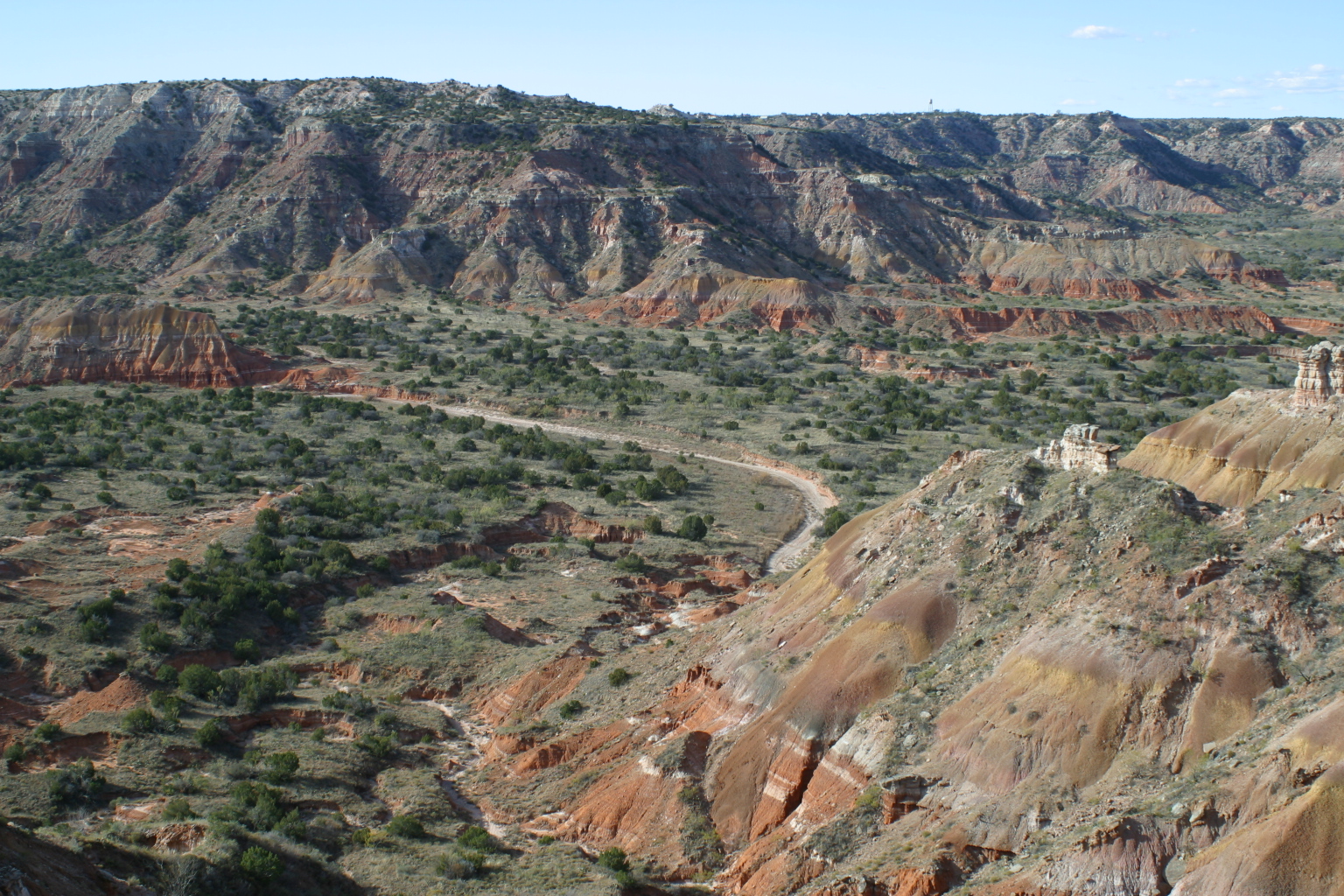
Image result for palo duro canyon historical 
 
Wikimedia also helped out with the above image - obviously not to the period and potentially not visible from the train - but it at least gives you an idea of the views from the Palo Duro Canyon.
 
Little known fun-fact: Artist Georgia O'Keeffe lived in Canyon, Texas at the time that Howard was riding through. She was a faculty member at West Texas State Normal College at the time, and it's believe that she was inspired the Palo Duro Canyon in her distinctive Southwest style.

Wednesday, October 26, 2016

Through St. Louis and Kansas City - 9/10/1916


Kan. City, Mo.
Sun, 10, 16

My Dear Parents: -

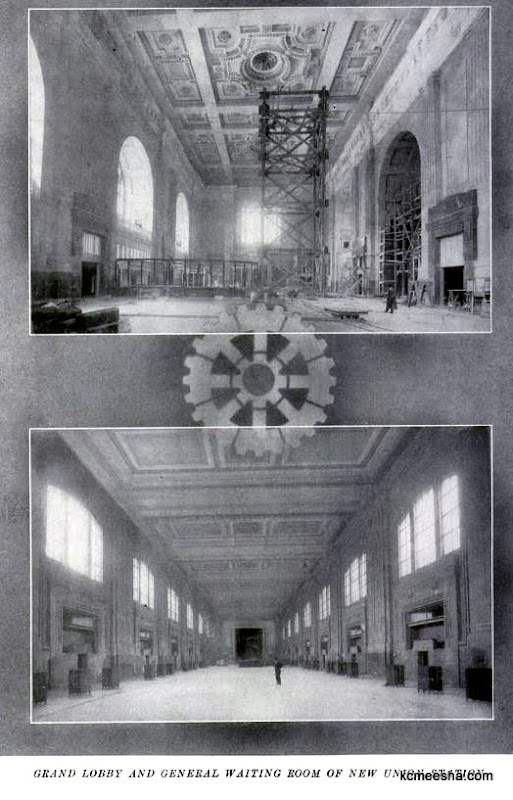
We are stopping over here for dinner and to replenish our ice & water supply. They have a grand depot here now, one like you read about in story books.

We crossed the Miss. river at 9:40 Sat night. Our route from Toledo was Marion, Ind.; Oakland, Ill; St. Louis. Mo.; Glasgow, Mo; Kan City, Mo.; Gardin, Mo.; Trinidad, Colo.; Albuquerque, N.M. & Ft Bliss, at El Paso Tex.

We changed engines at St. Louis, directly in front of the Hoyt Metal Co, from which the folding cup came that Dad had in the fruit basket.

At Charleston, Ill., and Kan City we got off and marched for a half hour to limber up.

We (Lisle, Sergt Walker & myself) had our Sunday dinner out of the box and some Lemonade, there was enough left so that we will be able to get our supper from it, and what is left in their boxes.

We are sure having a swell trip, and at every station which stop to get water, etc., a crowd is there to greet us.

Love to all
Howard

This will probably be mailed at the next station.

Kansas City's Union Station is impressive by today's standards, let alone to an 18-year-old from Ohio in 1916. When Howard stopped in Kansas City, Union Station was only two years old. It cost $8,000,000 to build, and an estimated 100,000 people arrived on opening day.

Tuesday, October 25, 2016

On the Train to El Paso - 9/8/1916


On Train
Sept 8, 1916
1:00 P.M.

My Dear Parents: - At last we are out of Camp Willis, the last ones to leave. We loaded the trains last evening and entrained this A.M. about 10:30. Gov. Willis came to the crossing and shook hands with each one of us.

Don't believe anything the papers say about our being tried for walking out of camp, because they have made an awful mess of everything that they have printed so far.

The only probable outcome of the affair will be a day or two of extra details and better eats.

There was no violence nor breaking into stores, etc., we just took a little vacation. We had a good time the two days we were in jail and were treated fine. The only reason they put us there was because it was the only place that they could accommodate 32 fellows.

As soon as I have a decent opportunity I will tell you all about it.

There is no disgrace connected with anything we did and it is taken as a joke.

We are going to Ft. Bliss at El Paso and expect to return at least by Nov. the first. Please don't worry about me for I am having a good time and feeling fine.

Love to all
Howard


The above photo is courtesy of Alexander F. Barnes and shows National Guardsmen boarding the train that will carry them across the country to Mexico in 1916. It's unknown from which state these guardsmen hail.

Troops were mostly transported in Pullman tourist train cars, so their comfort was generally good considering the long journey. According to the Railway Age Gazette from December 1916, "Official reports from all military departments showed that no organization moved in coaches in less space than three men to every four seats and wherever possible two seats for each man."

I could not find the newspaper articles that Howard references online (romantic date with microfilm to come). Interestingly enough, I did find a similar article in July 1916 that mentioned a company from New York who stopped in Cleveland for food, who acted in a similar manner that Howard described (breaking into stores, looting, etc.). I wonder if that was the running theme to sell papers at the time.

Monday, October 24, 2016

City Prison Cafe - 9/6/1916


Columbus, Ohio
Wed, Sept. 6, 1916

My Dear Parents: - 

You have probably heard about our company walking out Mon. because of the rotten food. We got caught before night and are in the city prison. I don't know whether or not we will get out before Sat. The eats here are better than those we got at camp. I am O.K. & don't want you to worry. We are not in single cells, but are all together, 32 of us are here in the lockup. We sing & raise the dickens in general. They treat us grand here and are all in sympathy with us. I am sure that the penalty will not be mush as the whole company are practically are refusing to do anything until we are properly fed. Don't worry if you don't hear from me for several days.

Howard


The above is a photo from the Columbus Metropolitan Library, showing the Columbus City Prison where Howard dined on fine food with his compadres in 1916. The prison burned in 1920. 

The city prison also served as the police headquarters at the time. I can imagine that the "jailers" probably did their best to make the boys as comfortable as possible. It sounds as if they may have even been more comfortable than at Camp Willis!

In his next letter (sent in the same envelope with this letter), Howard alludes to the newspaper coverage of this story, so I'll try to dig that up for next time. 

Sunday, October 23, 2016

Last Men Standing - 9/3/1916


Camp Willis, O
Sept 3, 1916

Dear Dad: - 

Mother's letter of the 1st. rec., rec. letter & card from Marion. Got a letter day or two ago from Merrick Hill, and one from Al Saal.

Well, 4th, 5th, 8th Regiments, Battery, Cavalry, Signal Corps 2nd Amb. and 2nd Field Hosp. have gone, about 7,000 or 7,500 in all. Only about 2,000 left.

Getting pretty darn lonely around here now. We still expect to get out of here by Sat. next.

There are about 30 or 40 Toledo visitors at our company today.

Weather has been great, nights fine for sleeping.

Feeling fine and anxious to get moving. 

Love to all
Howard

Got a nice letter from Leona yesterday.


The above is listed as a "novelty postcard" from the UA archives. Guessing that Howard wouldn't have had much to do other than to "dream" about going off to El Paso.

As quickly as Camp Willis went up, it was dismantled just as quickly, later becoming Upper Arlington's business district. When all was said and done, Camp Willis itself was seen as somewhat of a debacle for the Ohio National Guard. Many of the men who came to Camp Willis enlisted amidst a period of great patriotism - they were ready to stand and fight for their county. However, the site for Camp Willis wasn't ready to receive them, which is why many other states' units were called to the border before Ohio's. Guardsmen arrived to shortages in equipment and drilled for weeks without any news of when they would be moved to the border. Understandably, morale was low, considering the men had enlisted with the understanding they'd be moved quite quickly to battle the Mexicans. "Either go into Mexico or go home" was a popular slogan for troops at Camp Willis.  (Kingseed)

I found some interesting information about Al Saal on Magicpedia (who knew?). Al was a few years older than Howard, perhaps a friend of the family. He gave his first show as a magician at age 18, dressing in Spanish costume, doing card and cigarette manipulations. He is known as being the first magician to manipulate fully-lit cigarettes. He eventually retired from the "business" and became an undertaker. 

Saturday, October 22, 2016

Pinching Pennies - 8/27/1916

Camp Willis, O.
Aug. 27, 1916
My Dear Mother: -

As I want to get this on the night mail, I shall just write a few lines.

Pretty cool all day, with a slight shower now and then.

Only one visitor from Toledo at our camp today. I was at the station with one of the fellows when the train came in. From the looks of the crowd I don't think there were more than 40 or 50 people from Toledo.

I am sending you a receipt, which was in my note book. Guess you had better keep it for me.

We had a fine dinner & supper today. Am feeling fine.

Love to all
Howard


Wow, Howard. You really know how to impress a mama with those receipts! I guess all of his accounting prowess runs in his blood, considering his father John was a treasurer at an oil company. Not surprisingly, <Spoiler alert!> Howard never ended up in the medical profession after the war. Rather, he continued in business like his father. In 1930, the census listed him as buyer in an auto factory. In 1940, he was a purchasing agent like his father before him.

Minding pennies must have gotten the Goods far. John and Effie had live-in "servants" as listed in the census in 1920, and Howard and Leona also had servants living with them when my Grams and her sister Sue were small in 1930. I find it kind of funny that the only "hoity toity" branch to be found in my family tree is the Goods, considering that Grams was adopted and we're not related by blood. Only white trash running through these veins!

Friday, October 21, 2016

Farewell, Columbus Girl - 8/18/1916

Aug. 18, 1916
 
Dear Dad: -
 
Well, I have learned that "Students" in such collages as Yale & Harvard were the only ones who could get discharges. I only asked for a "Leave of absence",  but the "Skipper" said, "Nothing doing."
 
I put on my application that the reason was to finish Hi school work in order to prepare myself to take up surgery. Capt. said that since that was my inclination, that he would make me assitant "sawbones." You see there is one sergt. and usually one assist. who dishes out the pills etc. and who gives the propholaxis and such other disease preventitive treatments.
 
They have been drilling us so hard lately that I don't always get a chance to write when I want to but I shall write every chance I get even though it may be several days before I get a chance.
 
Wed. night I was with my Columbus girl again. I spent the evening at her home, had a peach of a time. I am going to see her again Sat if I get my pass, as it will be my last chance, we expect to leave here by the middle of next week. It was said that we shall be rushed to some place as about half of the high militia officers have threatened to resign if they soon don't see active service, they say that they all have better paying jobs, which are going to ruin becuase of their being held here, and they claim that the worse of it is that they are not doing anything here for any great benefit of their country.
 
If we leave as is said I shall have my clothes sent to you at the company.
 
I am feeling better every day. My stomach is getting used to this rotten regulation grub that we get shoved to us and I think that I shall begin to pick up a little weight presently.
 
I got a letter from Miss Ruth Felt yesterday. That makes about about a half a dozen letters I have rec. from her since coming here.
 
Marion's letters came today with the pictures. Thank her for me for sending them.
 
Love to all
 
Howard
 

Another "peach" of a photo from the UA archives is above. I'm sure Howard got his fair share of beans!

Howard references sending his clothes to "the company". The envelope of this letter was addressed to the "S.M. Jones Co., Segur Ave." where John Good likely worked. According to Ohio History Central, the company's founder, Samuel Jones, became rich after striking oil near Lima and founding the Ohio Oil company, which later became Standard Oil. He was known for providing his workers fair wages and safe working conditions and eventually ran on his "Golden Rule" philosophy for mayor of Toledo in 1897. He won the election and died in office in 1904. We don't know exactly what John did at S.M. Jones in 1916, but in 1910, his occupation was listed on the census as a Treaurer for "Mfg Gas Engines". In 1920, he was working as a purchasing agent in oil supplies.

I guess this letter answers the question about my previous post about whether Howard was engaged to Leona...or at least I hope he wasn't after his mention of his "Columbus girl"! Considering that I can't find record of Leona ever living in Columbus,and, that Howard mentioned her by name in the previous letter, I'm guessing they're not the same person.

The Leona/Columbus Girl question got me to thinking more about Howard's situation, especially his age. At the time of this letter, Howard would have only been 18 years old. The application for his veteran's headstone states that his enlistment date was April 27, 1915, which meant he was only just 17 when he joined the National Guard. Another interesting detail is that Leona was three years older than Howard. So, it makes more sense that 17 year-old Howard wouldn't have likely proposed to 20-year-old Leona before he even finished high school. I'm looking forward to seeing hints of how their relationship may develop in future letters.


Thursday, October 20, 2016

French Leaves and Lost Letters - 8/9/1916


9:00P.M.
Camp Willis, O,
Aug 9, 1916
Dear Dad - 

At last I have a few minutes to myself. We drilled about 7 1/2 hr. today, which included about a 6 mile hike.

They are getting as strict as the devil around here now, we cannot leave camp to go to town anymore without a pass.

The Provost Guard stationed in the business section of the city are all armed with 35 rounds of ball-shot. This was done because of the trouble the rough-necks of the Infantry made when they went to the city. The guard is about 150 strong.

They court-martialed our 1st class private and our serg't, who took a "French Leave" of three days, this morning, the serg't was fined 6 days pay ($7.20) and confined to Co. street for 2 weeks, the 1st class private got 5 days fine ($3.00) and 5 days at hard labor at the 4th Reg. Guard house.

They draw 4 names a day for 48 hr. furloughs, if I am lucky I may get a chance to come home before we leave. I still have 60 cents and the fare is only $4.90 round trip. They keep telling us that pay day is not far off, they have been telling us that for the last 3 weeks. I don't know whether there is $5.00 in camp or not, besides some change needed for street-car fare and Beach fare, but if I get a furlough I will try to manage to make is some way or other.

I got a letter from Lamont's girl yesterday, she thinks that it is awful because Lamont can't come home whenever he takes a notion to do so.

I haven't heard from Leona since a week ago Tues., don't know whether or not she is back in Toledo yet.

I got a letter from cous. Anna Souder yesterday, she did not know to what Co. I belonged and the letter was sent to the 3rd. Reg., then to the 5th Reg., then to the 1st, 2nd., and 3rd. Field Hospitals, then to the 1st Amb. It was everywhere except the Signal Corps, and the Calvary & Battery.

Everything is about the same in camp, two of the fellows who took French Leave Sunday have not returned yet. 

Got a letter from Clarence Forman today, telling me he had been married 3 months and wouldn't change place with a single man for the world.

I feel better every day.

Love to all
Howard


The above image is from the Upper Arlington Archives, depicting the Post Office that bungled the delivery of Howard's letter from Anna Souder. Anna was the daughter of Howard's Aunt Ellen, his father's sister.

Howard's daily schedule likely was as follows, which was reported by a correspondent with the Kenton newspaper at the time:

Morning the first call is made at 5:30, the assembly is at 5:45, and mess at 6:15. The troops drill from 7:40 until 11:00.  Mess is at 12:00, and drill begins at 1:30 and continues until 4:15.

Guard mounting call is at 4:40 and assembly is at 4:50. Mess is at 6:00. The men have the evenings, but the call to quarters is at 9:45 and taps at 10:00.

As Howard alludes to, his company was one of the State Medical Units - the 1st Ambulance Company which hailed from Toledo. According to Cole Kingseed's thesis, pay at the camp ranged from $16.67 per day for general officers to $4.72 for second lieutenants to $1 for sergeants. Howard was only a private at the time, so he would have earned 60 cents per day. 

This is the first mention of Leona, my great-grandmother. She and Howard were married in late summer 1920. Thus far, it is unknown whether they were engaged before Howard left. Leona was a nurse, so she likely would have had much in common with Howard in the ambulance unit.

Wednesday, October 19, 2016

The Storm at Camp Willis - 7/31/1916 and 8/2/1916


Camp Willis, O,
July 31, 1916
My Dear Mother -

I certainly had a good time Sunday when Uncle Tom was down.The feed he brought was great. I had my three meals out of it today and have some for tomorrow.

I guess he was all-in when evening came. There was a nice breeze all day but it was hotter than H---. The only thing that saved him was the thought of the fact that my woolen clothes were much better than his.

When I was coming home from the station, I met a man & his wife named Whitker. they knew Rev. Reeder of Toledo & Mrs. Phoebe Curtis. He said he had been on programmes with Mrs. Curtis. I showed them the camp by night and took them back to the car.

Received a letter from Ruth Felt Saturday. She is the same old girl.

(Same letter, continued)
August 2, 1916

At last I've formed time to finish my letter.

Everything was quiet & nice, with a few dark clouds in the north when suddenly the wind started to blow about 100 miles per.

The dust which was an inch thick on the ground made it impossible to see a thing. About 500 tents were blown down, blankets, clothes, hats & personals were scattered for miles. Many things were found at least three miles from where they started. All of our company were at Col.at the ball game. 

Only a few were at camp who did not care to go to the game. I was one at camp.

We managed to save all our own tents but two. I did not lose a thing & nothing of mine got wet or damaged.

One of the 2nd Field Hospital's men came around a corner of a building when the wind picked up and then threw him about 40 ft. against a building and knocked him senseless. About an hour later after the storm we found him there under a pile of debris. He's able to be around now. The wind took the roofs off the mess shacks & sure made some awful mess to clean up afterward. Everything was mixed up and many fellows lost everything they had.

Lightning struck several tents and burned them up. Four small circus tents used by the Army Y.M.C.A. were totally destroyed.

In one park uptown, over 75 trees were blown over, according to papers. It blew tops of street cars off & near camp where the land is high it carried about all the chimneys down.

I was not hurt, but am pretty sore in the back from tugging at tent ropes, etc. It rained for an hour after the wind so hard that the mud was nearly a foot deep.

I rec. your letter this A.M. I seem to stand the heat alright and feel better now than at any time since arriving here.

Love to all
Howard

Rec Marion's and Dad's letters also.

The above photo from the Upper Arlington, Ohio archives depicts soldiers of the 4th regiment and the tents to which Howard alluded. In spring 1916, President Woodrow Wilson called for the mobilization of the Ohio National Guard to assist in a campaign to seek and punish Pancho Villa for a raid in Columbus, New Mexico. At that time, Upper Arlington was a newly formed city, which was completely taken over when 8,000 National Guard troops used Camp Willis as a place to prepare for the protection of the U.S./Mexico border.

Although we don't know exactly when Howard arrived at Camp Willis, the camp was not ready to receive the Ohio Guard until June 27, 1916. So, he could have been there for a as long as a month when he wrote the letter.

Howard mentions the company in "Col. at the ball game". Conveniently situated close to the city of Columbus, Upper Arlington offered two streetcars that provided easy access to the location at that time: one running to the intersection of Fifth and Upper Arlington Avenues and the other ending at Fishinger Road, just north of Griggs Dam. It's hard to say which ball game they saw exactly, but it likely could have been a Columbus Senators baseball game. Football teams (Ohio State and the professional Columbus Panhandles) would not begin their seasons until October.

The "Marion" referenced in the letter is Howard's sister. I could not find records of "Uncle Tom" - neither Howard's father John, nor his mother Effie, had any siblings with the first or middle names of Thomas.

Tuesday, October 18, 2016

Letters on Leith

I said goodbye to my grandparents' house this weekend. Thankfully, I still have Gram for a little while. Her hearing may be gone, and her hugs may be sharper, but her spirit and humor are still alive and well.

It's hard to process that soon, the little white house on Leith Street will no longer be ours to enjoy, to be comforted by, to come home to. As I helped to clear out her house, I devoured 65-years-worth of photos (complete with negatives, organized by year in shoeboxes). I relished dozens of Christmases, birthday cakes, neighborhood parties, home improvement projects, and card games. All within the four walls of that little house.

I took a few things from the house - some Tiger figurines (Gram loves African animals),  the old clock that hung above Gramps' tool bench, Grams' baby book. They are just things, but things that reminded me of those I knew and loved.

One of those things, though, gave me a bigger gift -  a chance to get to know-and-love someone whom my Grams knew-and-loved, my great-grandfather, Howard J. Good. Tucked away in the attic, my aunt found Howard's letters from a hundred years ago. They were written to his parents during his time in the service during World War I.

Howard passed away during Grams' first semester of college. That meant he never got to meet his son-in-law, grandchildren, or great-children.  Yet, as I begin to read these letters, I hope to get a chance to know him and love him too.

Stay tuned to this site - as I read each letter, I'll post it here, providing as little non-expert commentary as I can muster. Enjoy!